
The 70th Eurovision Song Contest is here, and it is taking place in Vienna, Austria. The Grand Final is on Saturday 16 June 2026 at the Wiener Stadthalle, with Semi-Finals on 12 and 14 May. Austria earned hosting rights after JJ won in Basel in 2025 with "Wasted Love", making this the third time Vienna has hosted the contest. For UK fans, this year brings a genuinely interesting entry in Look Mum No Computer, even if the bookmakers are not backing him to go all the way. Here is everything you need to know about the odds, the favourites, and where the UK stands heading into the final.
The Favourites: Finland in a League of Their Own
Finland are the big favourites to triumph in the 2026 edition of the contest. Having been 4/1 favourites back in February, support for Linda Lampenius and Pete Parkkonen has been strong, with their odds now as short as 5/4 with the leading bookmaker. Based on aggregated live data from 26 major bookmakers, Finland currently leads the Winner market with a striking 37.4% consensus win probability. That kind of market dominance at this stage of the contest is rare and reflects genuine confidence from bookmakers and punters alike.
Here is the current top five in the betting:
| Country | Artist / Song | Win probability |
|---|---|---|
| Finland | Linda Lampenius & Pete Parkkonen - Liekinheitin | ~37% |
| Greece | TBA - Ferto | ~20% |
| Denmark | TBA - Før vi går hjem | ~11% |
| France | Monroe - Regarde! | ~7% |
| Australia | Delta Goodrem - Eclipse | ~6% |
Odds are indicative and sourced from major UK bookmakers. They may change multiple times daily as the final approaches. 18+ only.
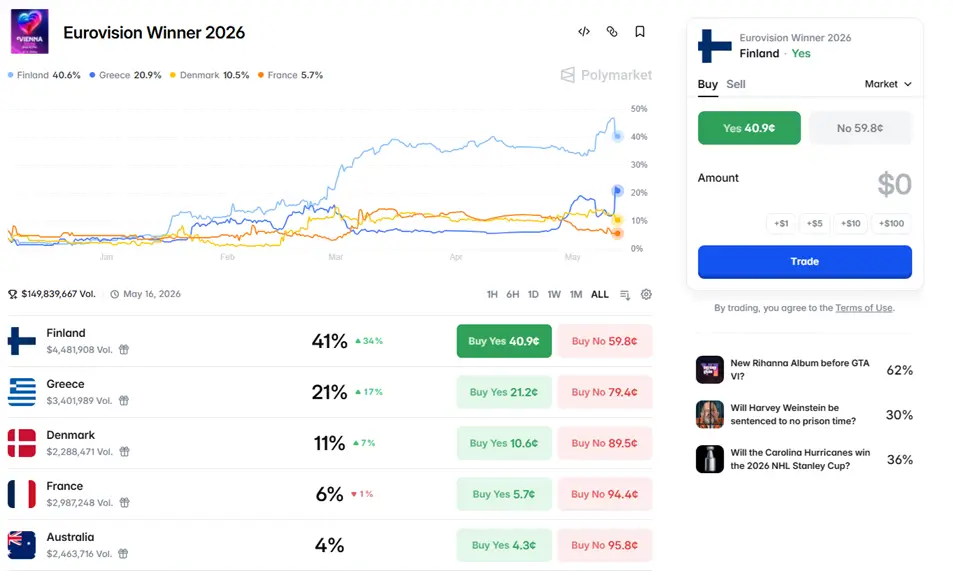
The Eurovision 2026 betting market reacted strongly following Monday night's Semi-Final 1 Jury Show, with Greece making a significant move towards Finland at the top of the rankings. While Finland remains the bookmaker favourite, the gap between first and second place has narrowed considerably overnight.
The UK Entry: Look Mum No Computer
The United Kingdom is represented at Eurovision 2026 with the song "Eins, Zwei, Drei", performed by Sam Battle under his stage name Look Mum No Computer.
Kent-based and self-proclaimed "backyard engineer" Look Mum No Computer is a YouTuber, musician, inventor and electronic aficionado. He has amassed an online fanbase with 85 million views and 1.4 million subscribers through building and playing instruments made from unusual materials, including Furbys, Game Boys, synthesiser bicycles, flame-throwing keyboards, and a Star Wars droid orchestra.
It is one of the most unconventional UK entries in years, and that cuts both ways at Eurovision.
At odds of 25/1, the UK's chances of winning can be interpreted as relatively slim but not impossible. The 2026 entry stands out for its eccentric synth-driven style and playful, unconventional presentation, which could help it capture attention in a crowded field. Eurovision often rewards memorable staging and distinctive acts, meaning a performance that goes viral or creates a strong visual moment can quickly outperform expectations.
At the same time, entries that lean heavily into novelty sometimes struggle to score highly with juries, which form half of the overall vote, potentially limiting how high they can climb even if viewers respond positively.
The realistic target for the UK this year is a top half finish rather than the podium. A strong staging and a crowd that responds to the energy of the performance could push the odds in the right direction before Saturday.
How Do Eurovision Odds Work?
If you are new to betting on Eurovision, the numbers are straightforward once you know what you are looking at.
Fractional odds like 5/4 mean you win £4 for every £5 you stake, plus your stake back. Decimal odds like 2.25 mean you receive £2.25 back for every £1 staked, profit included. The lower the odds, the more likely the bookmaker thinks that outcome is.
Odds will shift as new songs are revealed, rehearsals take place, and fan predictions roll in, so timing your bet can make a real difference. The market for Eurovision is particularly fluid in the days before the final, as staging rehearsals can dramatically change the picture. An act that looks weak on paper can surge if the live performance lands, and a frontrunner can shorten even further after a stunning jury show run-through.
Have the Bookmakers Been Right Before?
More often than not. Between 2015 and 2024, the pre-contest favourite won outright in several editions, including Sweden in 2015, Italy in 2021, Ukraine in 2022 and Sweden again in 2023. The bookmakers called each of those correctly.
But Eurovision always has surprises. In 2024, Croatia was the betting favourite heading into the final, and Switzerland won. The bookmakers' number one does not always take the trophy, but the winner is almost always somewhere near the top of the market before voting begins.
Where Can UK Punters Bet on Eurovision?
UK punters can bet on Eurovision at William Hill, bet365, Betfair, Paddy Power, Ladbrokes, Sky Bet, Coral and Betway. All of these are fully licensed by the UK Gambling Commission and legal for UK-based customers.
William Hill combines competitive Eurovision betting odds with various promotions, often tying special offers or free bet deals directly to the contest. Betfair's key advantage for Eurovision punters is the ability to bet via both its traditional sports betting platform and the unique Betfair Exchange, giving you the flexibility to back selections at fixed odds or trade positions by laying outcomes.
Markets available beyond the outright winner include Semi-Final Qualifiers, Top 10 Finish, Jury Vote Winner and Country Match-Ups. There are plenty of ways to wager on the contest beyond simply picking the winner.
How Reliable Are the Odds as a Prediction?
The odds aggregate the judgement of thousands of bettors and the analysis of professional traders. They are a better guide to likely outcomes than fan polls, which tend to reflect enthusiasm for a song rather than a realistic assessment of how juries and televoters across Europe will respond.
That said, Eurovision has structural quirks that make it harder to call than most events. Bloc voting patterns, staging surprises on the night, and the split between jury and televote all introduce uncertainty that the market cannot fully price in before the final begins. Several countries are expected to experience volatility following upcoming rehearsals and televised performances.
The smartest approach is to treat the odds as a useful guide to the shape of the contest rather than a certainty, and to watch for market movements as rehearsals progress this week.
Bottom Line
Finland goes into the Grand Final as the clearest Eurovision favourite in years. Greece has closed the gap significantly after a strong jury show performance, and Denmark remains a credible threat in third. For the UK, Look Mum No Computer is an outsider at 25/1, but Eurovision has a long history of rewarding acts that stand out from the crowd and there is very little on the Eurovision stage quite like this one.
The final is on Saturday 16 May at 21:00 CET, broadcast live on BBC One and iPlayer.